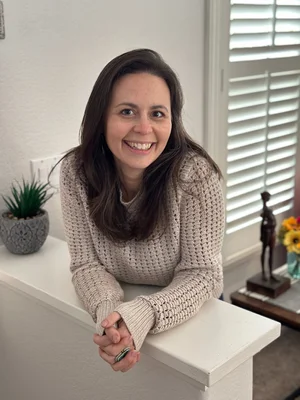
Making room for the magic, the worry, and everything in between.
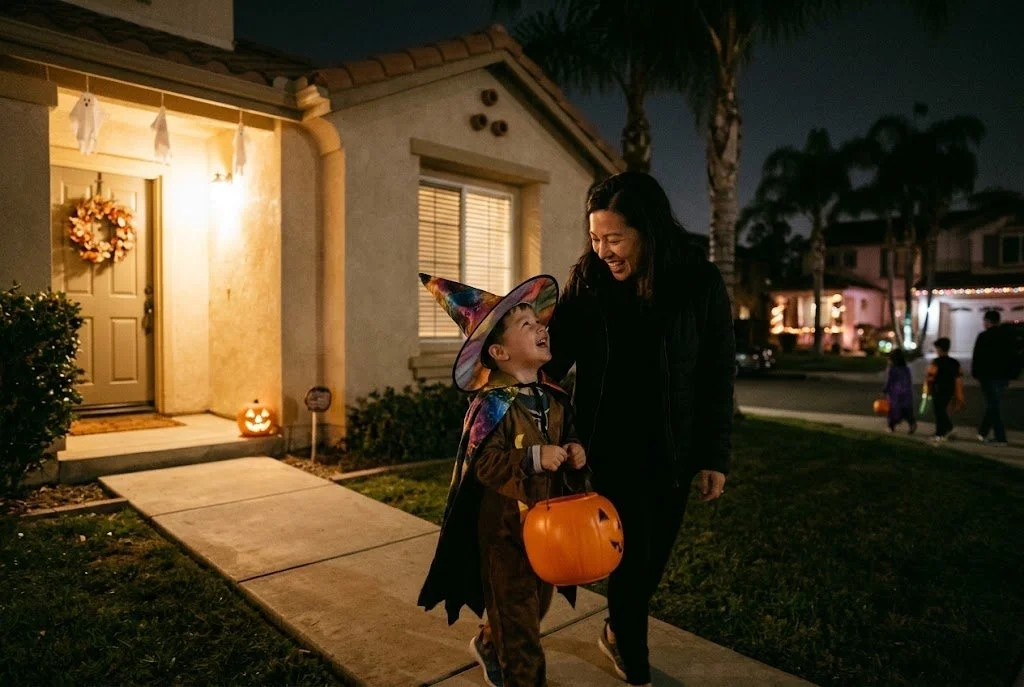
Halloween asks us to hold two things at once: make the night magical and keep everyone safe. Add our memories, our expectations and a lot of unknowns, all after dark and past bedtime, and it's no wonder our hearts race, even when we want to be enjoying ourselves.
Why is Halloween such a complicated holiday?
A lot of us have good memories of Halloween as kids: the fun, the costumes, the feeling that anything could happen. We want to make that happen for our kids. Some of us are on the other end, carrying harder memories and trying to do it better than it was done for us, or figure out a different way. (That's a story for another post.)
On top of memories, there are expectations: the picture, the costume, the magic. And there are logistics: who is where? Whose shoes are on? Who still needs dinner?
Is Halloween scary for moms, or is it our own expectations?
It's probably not a shocker here, but in true Ellie fashion, it's both. It's a "two things are true" day and that's why the night feels so loaded.
There is the real stuff: it's dark, there are crowds, and our kids are excited and running toward strangers' front doors. And there is the pressure we put on ourselves to make it all go right. That adds up to a lot of unknowns and a lot of uncertainty, all happening after dark.
Surprise, it isn't only in your head. Researchers who study how households run have found that women tend to carry more of the invisible work, the anticipating and the monitoring nobody sees. Halloween packs a whole lot of that into one evening.
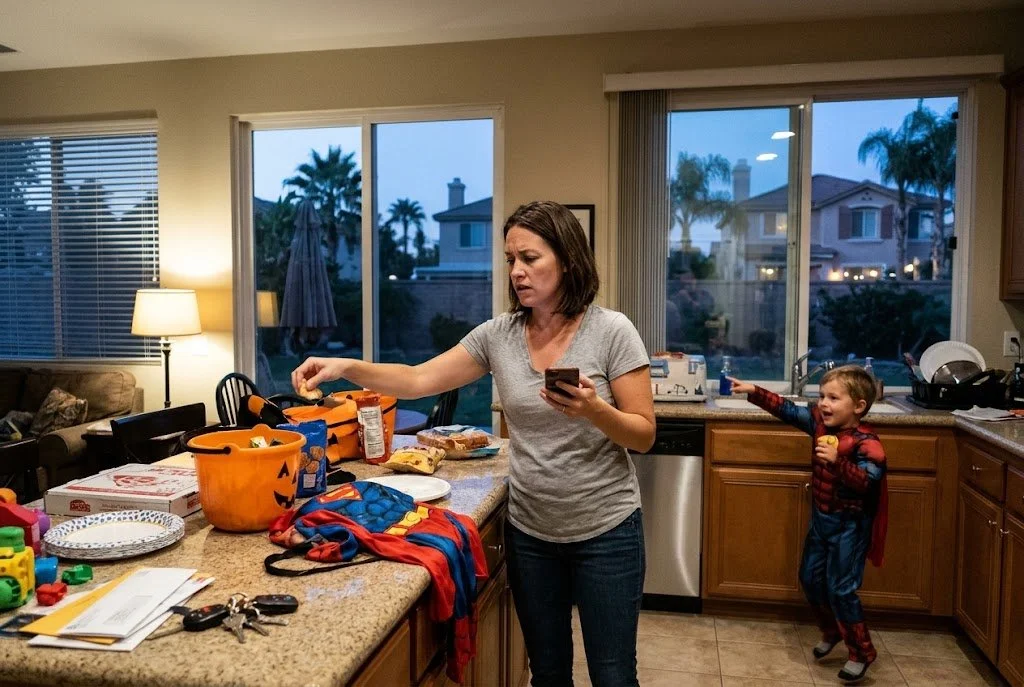
On Halloween (and many other holidays if we are being real) we're also often pushing our kids a little past their limits, with sleep, sugar, excitement, and taking a chance on believing it's going to be okay. That chance and that uncertainty can turn everything up to 11.
The heart races. The body gets tight. For whatever reason, we feel like we're not enjoying ourselves even though we want to be. We just feel "a little off".
Nothing is actually wrong with us. What is happening is a protective mind at work on a night with A LOT to protect.
Why does it feel like we have to choose between the magic and the safety?
Here's the tug-of-war underneath it all. Part of us wants Halloween to be fun, silly and magical: the costumes, the porch lights, running all around the neighborhood, the pictures and the memories our kids get to keep. Another part of us is scanning the street, counting heads, bracing for what could go wrong.
Both parts come from love. The one that wants the magic and the one that watches for danger are actually trying to protect the same thing: our kids' experience of the night.
The trouble starts when we treat them like opponents and one of them has to win. When the magic part is in charge, we can feel guilty for every worry. We shame ourselves for any moment we have a hard time and put immense pressure on the night. However, when the scanning part is in charge, we can completely miss the moment we were trying so hard to protect, and then feel ashamed about that too.
Either way, we end up measuring ourselves against the idea of a perfect night that doesn't exist.
Here is the good news: we don't have to pick.
When we've already answered a worry on purpose, it can get quieter. So try to decide ahead of time what safe enough looks like for your family. Don't keep re-analyzing it. Let that safe enough be your checkpoint, and then let the decision be done. If something actually changes, you can respond to that, too.
And the magic our kids remember is rarely the plan going right. So decide what good enough looks like there. My honest strategy is to use my observations of them and their joy as a better meter than whether the picture went well and things were on time.
It's about us being there, even if dinner is a granola bar and an apple on the road.
What do our kids pick up on?
Our kids are paying attention to us, often in ways we don't realize. Our emotional states can influence theirs, and theirs influence ours, too.
Research has found that mothers' stress responses and infants' physiological responses can move together. In one lab study, researchers put mothers through a stressful experience and then reunited them with their babies. The babies' bodies reflected changes in their mothers' stress responses, too.
That study was with infants, so it can't tell us exactly what happens with a big kid on a stranger's porch. But it gives us something to think about: our state is one part of the environment we're creating together.
That is not a reason for guilt or to worry that you have to be perfectly calm all the time. It's rather a reason to be kind to ourselves, and to give our bodies a little help.
If you want your kids to be able to roll with the punches, adapt and find flexibility, especially on a night when that last house just feels too far and everyone is tired, our ability to model that can go A LONG WAY.
It might require that extra moment before responding, re-checking the facts, observing the moment and taking it one step at a time. Isn't that what you want them to pick up on? Not perfection but regulation and the ability to be flexible and self-aware even when overwhelmed.
So how do we show that?
What if we name it?
What if, instead of pushing through, we say it out loud?
"Gosh, this night makes me a little nervous. I'm not as calm as I want to be."
There's some grounding for that. In one national children's hospital poll, moms were nearly twice as likely as dads to report high holiday stress, and the folks behind that poll suggest something pretty simple: say what we're feeling out loud, and pair it with one small action, like "I'm feeling overwhelmed, let's take a five-minute dance break." That poll was about winter holidays, not Halloween, but the idea carries over.
Naming it also invites our kids to notice their own feelings, which is a skill we want them to have. Just like that flexibility I mentioned before.
Personally, I like to take it up a notch and ask myself: What if I let a little more of the good in, too?
Think of the feeling you crave when you get a touch of joy, like a giggle or a good look at a costume. Could you let it spread a little further? When you hear the giggle, can you embrace it just a little bit more or a little longer?
Not as one more thing to get right. Just as an invitation: what if we let a little more in?
Now this can get hard when emotions are dipping and meltdowns feel imminent.
So, what helps when our kids are melting down?
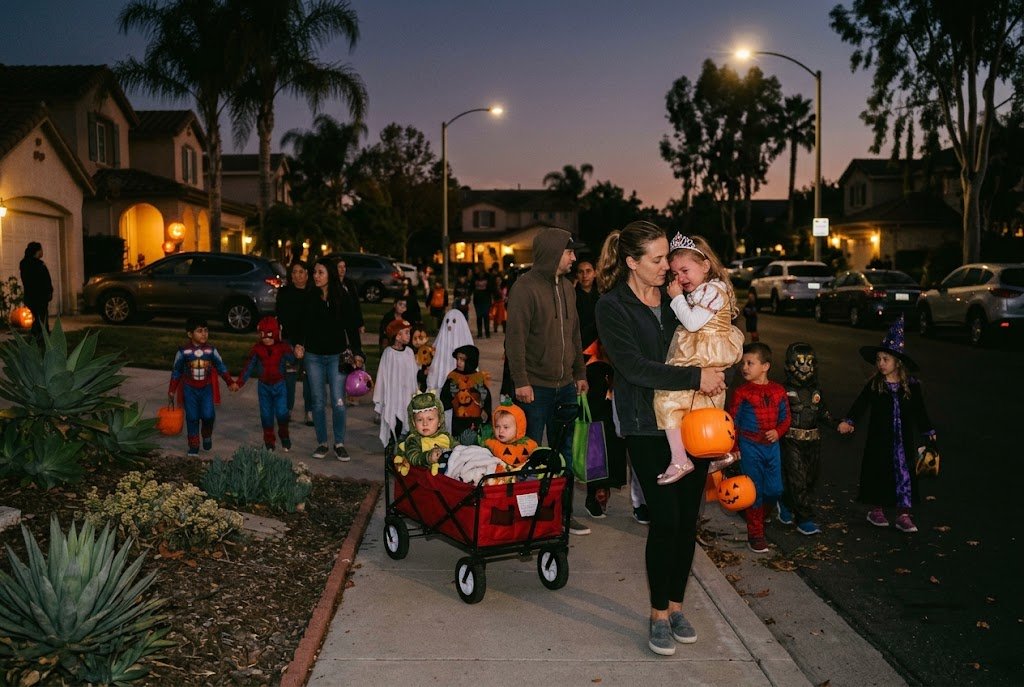
When our kiddos are whining or upset, instead of letting all the discomfort wash over us, we can see if we can take the breath we need, then observe them and figure out what they need.
This is what we explored at The Mama Lunch Break this month: taking our observational skills into the holidays.
Think about it like doing an observational body scan of your kiddo. Really take in what you see and hear coming from them, along with what you know about their typical needs. That information is often exactly what you need to de-escalate the situation.
Is your kiddo ice cold and shivering? Get them a blanket or take a break to warm up. Is your kiddo scared? Don't make them walk up alone. Stay with them and offer your presence. Maybe your kiddo often has a hard time in crowds, so take them to a spot that is quieter.
Of course, when we're anxious ourselves, noticing these things can be much harder than it sounds.
So, remember to circle back to that "good enough" concept we talked about before. I can't promise this will stop your worries in their tracks, and I don't think that's the goal.
But if we can notice a worry, check it against the facts, and figure out what is actually happening, often our bodies can settle enough for us to observe ourselves and our kids at the same time. That gives us more room to figure out what to do next.
Putting it together
1. Decide what "safe enough" looks like before we go.
Make those decisions ahead of time so we have a checkpoint to return to, rather than starting over with every worry. If something changes, we can respond to that too.
2. Look at the kids in front of us.
What do we actually see and hear? Add what we know about their usual needs. Are they struggling, or are they enjoying a moment we get to lean into?
3. Let that guide what happens next.
We can adjust the plan to meet a need, or let ourselves take a little more of the good in. The actual experience of it matters more than the picture or the schedule ever will.
The worry doesn't have to disappear. We can keep coming back to what's needed right here.
Please remember as you dive into Halloween and the many holidays that follow, you don't have to choose between the magic and keeping everyone safe. Both come from the same love.
Does your Halloween feel a little complicated too? You're not doing it wrong. Reach out and we can explore what is loudest for you so you can find the balance you deserve on the holidays and every day.
By: Ellie Messinger-Adams, LPCC
Founder and Therapist at ēma therapy
Offices in Encinitas and San Marcos
Telehealth across California
Sources
The research alluded to above, in full:
Waters SF, West TV, Mendes WB. Stress contagion: physiological covariation between mothers and infants. Psychological Science, 2014;25(4):934-942. https://pubmed.ncbi.nlm.nih.gov/24482403/
Daminger A. The Cognitive Dimension of Household Labor. American Sociological Review, 2019;84(4):609-633. https://doi.org/10.1177/0003122419859007
C.S. Mott Children's Hospital National Poll on Children's Health. 'Tis the season to be...stressed? December 20, 2021. https://mottpoll.org/reports/tis-season-stressed